
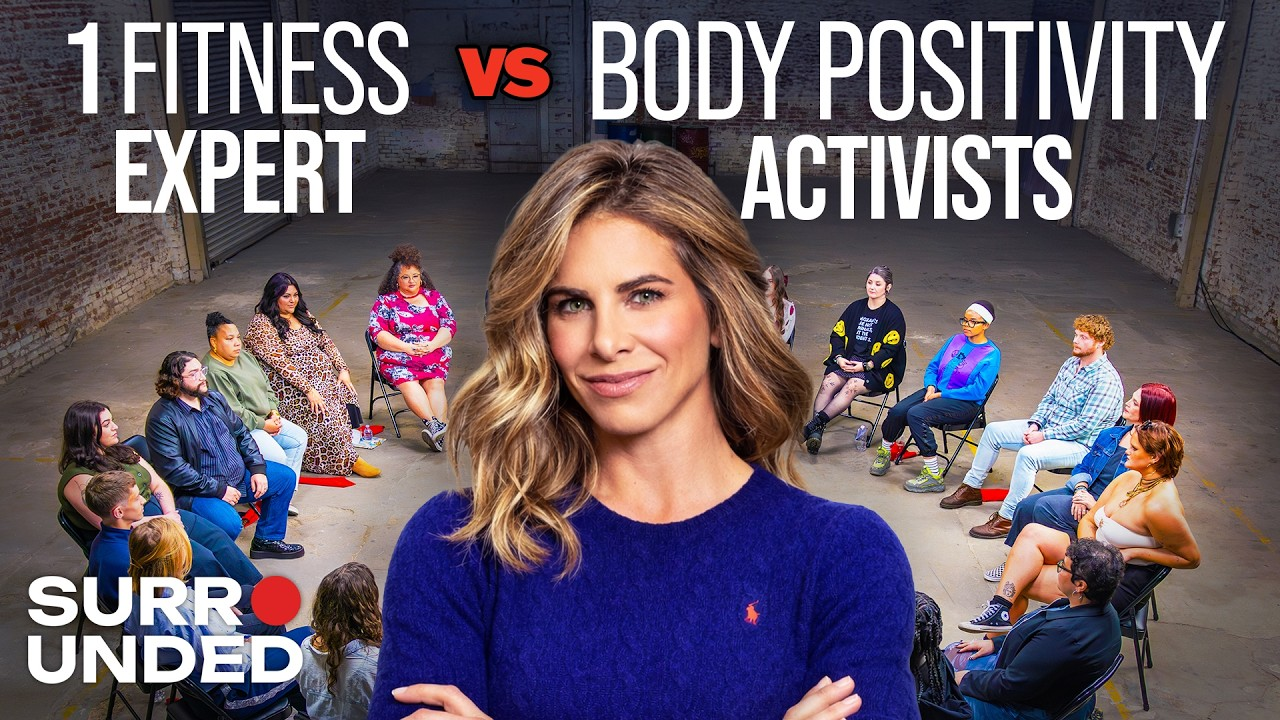
Jillian Michaels on the Jubilee channel debating the effects of obesity and the inconsistencies of the body positivity movement.
“Healthy at any size,” “I can eat what I want, ”and “weight and health are unrelated,” are the many repeated phrases that come from the body positivity movement, a practice that asserts that all body types should be acceptable.
About a week ago, fitness expert and health advocate Jillian Michaels debated 20 body positivity members on the debate style Youtube channel, Jubilee. During the exchange, Michaels went on to describe the intent of health advocacy, the food industry, and most importantly, the negative effects of obesity.
After watching the video, it was easy to see how opposers of Michaels frequently softened the seriousness of obesity to support overweight people.
The debate was important because it highlighted how avoiding honest conversations about the health risks associated with obesity — often out of concern for protecting feelings — may contribute to a standard where risks related to obesity are downplayed, ultimately failing overweight and obese people.
During the video there were two examples of softening obesity that exceptionally stood out.
Edie, the eating disorder therapist.
Edie was the first debater to sit down with Michaels, and from the beginning, her defense leaned heavily on emotion and avoiding any offense toward overweight people.
“I’m going to do my best to not use the ‘O-word’ because I find it pretty offensive,” she said, responding to Michaels’ claim that obesity is objectively unhealthy.
What made Edie’s contribution especially memorable was the contradiction that emerged in her argument. During a later exchange, she corrected Michaels on a common body-positivity phrase, emphasizing, “It’s not ‘healthy at any size,’ it’s ‘health at any size,’” drawing a distinction meant to shift the focus toward individual health rather than body weight.
Yet moments later, she stated, “I mean, I personally believe you can be healthy at any size,” effectively collapsing the distinction she just insisted on. In doing so, she appeared to abandon her earlier clarification, perhaps to avoid offending overweight individuals at the cost of consistency.
This raises a broader question: how would such a framework apply in clinical contexts? For example, would an eating disorder therapist like Edie tell someone with anorexia or bulimia that they are “healthy at any weight”? If not, then the principle seems to require an implicit cutoff, one that gives privileges to certain conditions, like obesity, over others in an effort to avoid offense rather than maintaining a consistent standard for health.
“Positive affirmations.”
Toward the end of the video, a debater named Rachel spoke with Michaels about the relationship between shame and obesity.
Michaels argued that a constructive way to deal with shame is to identify its root cause and work toward meaningful behavioral change, rather than attributing the issue to external factors.
In other words, she described that those who struggle with weight may also be dealing with underlying, internalized issues that contribute to their habits while projecting the issue on third party factors. For example, a teenager overeating as a coping mechanism for a traumatic experience, such as their parents’ divorce, while placing the blame on societal pressures or media influences.
Rachel pushed back on this perspective, proposing instead that addressing shame should begin with comforting positive affirmations. She told Michaels, “You have to invite love into the space … by looking at yourself in the mirror and telling yourself, ‘I’m beautiful.’”
While this approach came off as compassionate, it oversimplified a more complex issue. Positive affirmations alone are unlikely to be as effective as directly confronting the underlying causes of internalized shame, particularly when those causes influence behaviors that affect long-term health.
A more productive approach would be to avoid oversimplifying the seriousness of obesity with purely feel-good language. Instead, it may be more helpful to communicate health realities constructively, encouraging individuals to seek support without diminishing the importance of their weight condition.
As Michaels put it, “Positive affirmations are like dealing with a bullet wound with a Band-Aid.”
Many advocates of the body positivity movement argue that obese individuals can live comfortably despite the commonly cited health risks associated with excess weight.
However, comfort alone does not negate those risks. And being reassured by others does not change the underlying health implications of obesity.
If body positivity becomes a justification for remaining overweight rather than a foundation for healthier choices, then it risks encouraging decisions that may be detrimental to long-term health.
Ultimately, the movement should not be used to avoid reality, but instead as support for change. Body positivity should create a safe space for people of all sizes to make healthier choices with their bodies.